
Олимпиада по английскому языку 7-8 класс 16-18 сентября 2026 ответы и задания школьного этапа

Всероссийская олимпиада школьников по английскому языку 7-8 класс задания и ответы школьного этапа 2026-2027. Данная олимпиада проходит у школьников Москвы 16, 17, 18 сентября 2026 года в 9:00 утра ответы и решение опубликованы после заданий.
Олимпиада по английскому языку 7-8 класс школьный этап 2026-2027
INTEGRATED LISTENING AND READING
Time: 30 minutes
Maximum points — 23
Frank and Laura are a brother and sister from New York. Together with their father they are visiting Moscow. Among other sites, they are going to see some metro stations.
Task 1
Read the texts about six metro stations in Moscow and answer the questions after them.
- Mayakovskaya Station (Green Line). This Art Deco masterpiece was opened on 11 September 1938, eight years after the death of the famous poet Vladimir Mayakovsky. Architect Alexey Dushkin designed the station, while artist Alexander Deyneka created 34 beautiful ceiling mosaics based on the theme “24-Hour Soviet Sky.” This station looks very modern and futuristic, and its full-size model won the Grand Prix at the 1939 New York World’s Fair.
- Tsvetnoy Boulevard Station (Grey Line). Opened on 31 December 1988, this postmodernist station was designed by architects Vladimir Filippov and Rimidalv Pogrebnoi. The station was built near the famous circus at the request of its director Yury Nikulin, who wanted children to have a more convenient way to get to the circus. Inside, the colourful stained-glass panel created by artist Vladimir Kalensky depicts three well-known clowns, but they are not easy to spot — it is a kind of puzzle.
- Ploshchad’ Revolutsii Station (Dark Blue Line). This station opened its doors on 13 March 1938 as a joint creation of architect Alexei Dushkin and sculptor Matvey Manizer. It is easy to recognize by its dark-red marble arches with 76 bronze life-size statues in the Socialist Realist style. The statues represent Soviet citizens such as farmers, athletes, soldiers and schoolchildren. Several figures have become good-luck charms; for example, touching the nose of the border guard’s dog is a famous ritual among students and tourists.
- TsSKA Station (Turquoise Line). This modern station opened on 26 February 2018, created by a design group headed by architect Nikolai Shumakov. Elevated on high pedestals, there are four life-size bronze sculptures of famous Soviet and Russian athletes, created by artist Mikhail Pereyaslavets. These traditional monumental statues create a nice contrast with the modern minimalistic ceiling decorated with images of different sports.
- Taganskaya Station (Circle Line). Opened on New Year’s Day in 1950, this station was designed by architects K. Ryzhkov and A. Medvedev to honour the Soviet armed forces. The station’s special artistic feature is its series of 48 triangular ceramic panels created by ceramicists E. Blinova, P. Kozhin and A. Sotnikov. These blue-and-white porcelain reliefs depict Soviet soldiers from different branches of the military surrounded by traditional floral motifs.
- Komsomol’skaya Station (Circle Line). Opened on 30 January 1952, this station is a typical example of late Stalinist Baroque architecture, created by legendary architect Alexey Shchusev and decorated with grand mosaics by artist Pavel Korin. Known as an “underground palace,” this station greets passengers with an enormous bright yellow ceiling, grand chandeliers and eight large mosaics depicting famous Russian military leaders such as Alexander Nevsky, Dmitry Donskoy, Alexander Suvorov and others.
ЗАДАНИЕ 1
Which station is the oldest?
- Mayakovskaya
- Tsvetnoy Boulevard
- Ploshchad’ Revolutsii
- TsSKA
- Taganskaya
- Komsomol’skaya
Ответ: Ploshchad’ Revolutsii
ЗАДАНИЕ 2
Which station is the newest?
- Mayakovskaya
- Tsvetnoy Boulevard
- Ploshchad’ Revolutsii
- TsSKA
- Taganskaya
- Komsomol’skaya
Ответ: TsSKA
ЗАДАНИЕ 3
Mark all the stations where you can see images of military people.
- Mayakovskaya
- Tsvetnoy Boulevard
- Ploshchad’ Revolutsii
- TsSKA
- Taganskaya
- Komsomol’skaya
Ответ: Ploshchad’ Revolutsii, Komsomol’skaya
ЗАДАНИЕ 4
Which two stations share the same architect?
- Mayakovskaya and Ploshchad’ Revolutsii
- Komsomol’skaya and TsSKA
- Taganskaya and Mayakovskaya
- Taganskaya and Tsvetnoy Boulevard
Ответ: Mayakovskaya and Ploshchad’ Revolutsii
ЗАДАНИЕ 5
Which of the stations received a prize?
- Mayakovskaya
- Tsvetnoy Boulevard
- Ploshchad’ Revolutsii
- TsSKA
- Taganskaya
- Komsomol’skaya
Ответ: Mayakovskaya
ЗАДАНИЕ 6
Установите соответствие между объектами двух столбцов
Match the decorative elements with the stations.
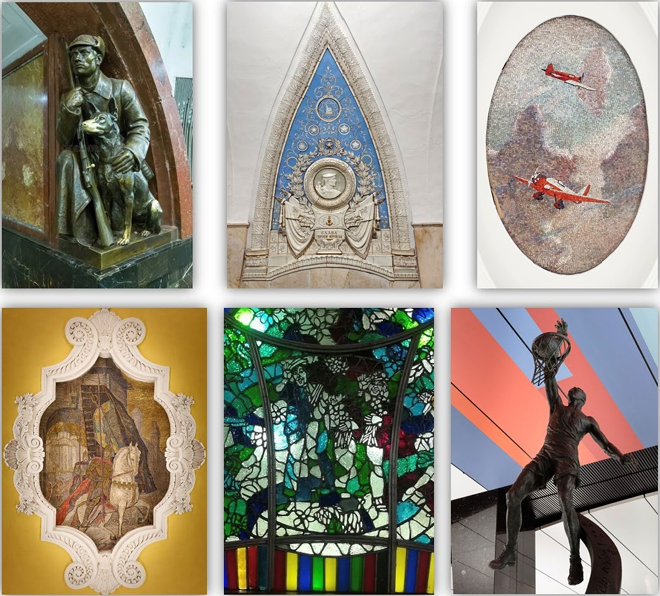
СЛАВА ГЕРОЯМ МОРЯКАМ
- Ploshchad’ Revolutsii Station
- Mayakovskaya Station
- TsSKA Station
- Komsomolskaya Station
- Tsvetnoy Boulevard Station
- Taganskaya Station
Task 2
Now listen to the dialogues between Laura, Frank and their father and answer the following seven questions. You will hear the dialogues twice.
Прослушайте аудиозапись
00:00 / 12:09
ЗАДАНИЕ 7
Before going to look at the metro stations, Laura, Frank and their father were most likely …
- in the Pushkin Museum
- at the Bolshoi Theatre
- in the Kremlin museums
- at the Moscow Conservatory
Ответ: at the Bolshoi Theatre
ЗАДАНИЕ 8
When Laura and Frank’s father says, “I’m ready to call it a day”, he wants to say that …
- it is still too light outside, even though it’s evening.
- he has chosen a day for some activity.
- he wants to go to bed.
Ответ: he wants to go to bed.
ЗАДАНИЕ 9
What month does the dialogue most likely take place in?
- January.
- June.
- November.
Ответ: June
ЗАДАНИЕ 10
The first station they visited was …
- Mayakovskaya
- Tsvetnoy Boulevard
- Ploshchad’ Revolutsii
- TsSKA
- Taganskaya
- Komsomol’skaya
Ответ: Komsomol’skaya
ЗАДАНИЕ 11
The second station they visited was …
- Mayakovskaya
- Tsvetnoy Boulevard
- Ploshchad’ Revolutsii
- TsSKA
- Taganskaya
- Komsomol’skaya
Ответ: Mayakovskaya
ЗАДАНИЕ 12
The third station they visited was …
- Mayakovskaya
- Tsvetnoy Boulevard
- Ploshchad’ Revolutsii
- TsSKA
- Taganskaya
- Komsomol’skaya
Ответ: Ploshchad’ Revolutsii
ЗАДАНИЕ 13
The fourth and last station they visited was …
- Mayakovskaya
- Tsvetnoy Boulevard
- Ploshchad’ Revolutsii
- TsSKA
- Taganskaya
- Komsomol’skaya
Ответ: TsSKA
READING
Time: 25 minutes
Maximum points — 17
Read the text below and do the following tasks.
The phrase “the Ides of March” sounds mysterious today, almost like the title of a forgotten legend. In ancient Rome, however, it was simply a date in the calendar — March 15th.
The Romans did not number days as we do now. Instead, each month was organized around three key markers: the Kalends (the 1st day), the Nones (the 5th or 7th day), and the Ides.
In March, May, July, and October, the Ides fell on the 15th day and the Nones on the 7th; in other months, they fell on the 13th and 5th days respectively.
Romans identified all the other days by calculating backward from the Kalends, Nones or Ides. They counted both the starting and ending days. For example:
| April 17 | “ante diem XV Kalendas Maias” | 15 days before the Kalends of May |
| July 4 | “ante diem IV Nonas Julias” | 4 days before the Nones of July |
| October 10 | “ante diem VI Idus Octobres” | 6 days before the Ides of October |
ЗАДАНИЕ 14
Напишите ответ в строке (без учета регистра)
The word Ides comes from an old Roman term meaning “to divide.” For the Romans, it marked the middle of the month and was often associated with the full moon. The Roman year originally had only ten months and began in March, and so the Ides of March was the first full moon of the new year. But over time, one particular date became unforgettable: the Ides of March in 44 BC.
On that
day, Julius Caesar — one of the most powerful leaders in Roman history — was killed in the Senate. According to the ancient historians Suetonius and Plutarch, Caesar had been told by a fortune teller that something bad would happen to him on the Ides of March. William Shakespeare (1564-1616) later made this moment famous in his play Julius Caesar, popularizing the phrase “Beware the Ides of March!” and turning the date into a symbol of fate, betrayal, and looming danger. Shakespeare based much of his play on Plutarch’s Lives of the Noble Grecians and Romans, which was translated into English by Thomas North in 1579.
So, there is a reason why the phrase “the Ides of March” sounds mysterious. We are not just talking about a date. We are remembering a sad moment in ancient history, and, at the back of our minds, thinking of Julius Caesar, William Shakespeare and the ancient historians Suetonius and Plutarch.
Can you think of a modern English word which sounds like / is connected with one of the ancient Roman words used for marking days of the month? Write one word in the box without any articles or punctuation marks.
ЗАДАНИЕ 15
The Latin word Nones comes from the Latin word Nonae, which means “the ninth”. Can you guess why ancient Romans used this word for this date in the month between the Kalends and the Ides?
- Because it fell on the 9th day of each month.
- Because it was 9 days before the Ides.
- Because it was 9 days after the Kalends.
ЗАДАНИЕ 16
Заполните пропуски подходящими по смыслу элементами
Match the modern dates with their names in Ancient Rome. There are 2 extra options that you will not use.
- The Kalends of September
- The Ides of September
- 17 days before the Kalends of October
- 7 days before the Ides of September
- 13 days before the Kalends of September
- The Nones of September
- 3 days after the Nones of September
- The Ides of August
- 15 days before the Kalends of October
20 August –
1 September –
5 September –
7 September –
13 September –
15 September –
17 September –
ЗАДАНИЕ 17
Mark all the correct answers:
The Ides of March is …
- the date when Julius Caesar was killed.
- a date in the ancient Roman calendar.
- a story told by ancient historian Plutarch.
- a title of a forgotten mysterious legend.
- a phrase that warns people about danger.
- a play written by William Shakespeare.
ЗАДАНИЕ 18
William Shakespeare …
- could read about
Julius Caesar’s life only in Latin.
- had a chance to read about Julius Caesar’s life in English.
- could hear about Julius Caesar’s life while talking to Plutarch.
- could hear about Julius Caesar’s life while talking to Suetonius.
ЗАДАНИЕ 19
Which title is the best for this text?
- 15 March, 44 BC
- Months of Ancient Rome
- The Ides of March
- Shakespear’s “Julius Caesar”
ЗАДАНИЕ 20
Выберите подходящий вариант в выпадающем списке
The Bike in the Window
Keshon was a schoolboy who lived in a quiet neighbourhood on the edge of town. After school, he usually (1) ___ the same route home and always slowed (2) ___ when he reached the shop window. (3) ___ was something inside that he could not stop (4) ___ about, and he often paused there for (5) ___ seconds before continuing on his way. Keshon pressed (6) ___ nose against the glass of the store window. It was (7) ___ third time this week. He stared longingly at the shiny red bike with a white racing stripe. As (8) ___ the blue price tag seemed to scream loudly at him, “Only $59.99!” But it did not make (9) ___ difference for Keshon, if it was $59.99 or a million. He (10) ___ the money to buy it. Keshon (11) ___ his wallet out of his hip pocket and counted the money. Keshon
had saved (12) ___ from walking his neighbours’ dogs. He (13) ___ counted $56.75. Just a few (14) ___ dogs to walk before (15) ___ bike became his. Just as Keshon was (16) ___ to walk away, the store manager (17) ___ to the window. He replaced the sign on the bike with a red “sale” (18) ___ sign! The new price (19) ___ $54.99. Keshon jumped in the air. He ran into the store with excitement. The store manager gladly accepted Keshon’s money and handed him the bike. Keshon hopped on his new bike and (20) ___ home, grinning proudly the whole way.
(1) walks / is walking / walked / was walking
(2) up / down / over / round
(3) There / Whear / Their / They’re
(4
) think / to think / thinking / thought
(5) little / a little / few / a few
(6) he / his / him / her
(7) — / a / an / the
(8) always, / whenever, / never, / sometime,
(9) any / many / some / no
(10) has not / had no / did not have / does not have
(11) take / took / was taking / has taken
(12) them
/ it / its / they
(13) slow / slower / slowest / slowly
(14) more / else / many / some
(15) a / an / the / —
(16) near / close / about / off
(17) come / came / was coming / to come
(18) — /
a / an / the
(19) be / will be / is / was
(20) footed / armed / faced / headed
USE OF ENGLISH. Task 2
Maximum points — 3
Below is a poem by the American children’s writer Shel Silverstine. Read it and do the tasks that follow.
**WRITESINGTEL
LDRAW**
By Shel Silverstine
(1) I’ve told you a hundred tall stories,
(2
) I’ve sung you a thousand sweet songs,
(3) I’ve wrote you a million ridiculous rhymes
(
- (Though sometimes the grammar was wrong).
(5) I’ve drawn you a zillion pictures,
(6) So being as fair as can be,
(7) After all that I’ve writtensungtolddrawn for you,
(8) Won’t you writesingtelldraw one for me?
ЗАДАНИЕ 21
Введите ответ в числовое поле
Find the grammar mistake that Shel Silverstine mentions and:
- write which line has a grammar mistake. Write its number (not a word).
ЗАДАНИЕ 22
- correct the mistake: rewrite the whole line without any mistakes. Be careful and don’t make any spelling mistakes! An answer with a spelling mistake will not count as a correct answer.
В поле для ответа запишите всю фразу с пробелами между словами. Проверьте ответы перед сохранением. Ответы, внесённые неверно, а также с ошибками или опечатками, будут засчитаны как ошибочные.
ЗАДАНИЕ 23
Write the title of the poem so that it makes sense.
В поле для ответа запишите всю фразу с пробелами между словами, без знаков препинания, дефисов и прочих символов. Проверьте ответы перед сохранением. Ответы, внесённые неверно, а также с ошибками или опечатками, будут засчитаны как ошибочные.
USE OF ENGLISH. Task 3
Maximum points — 5
Rowan was walking around the city, noticing interesting traffic signs. Answer the question about the following three of them.
ЗАДАНИЕ 24
Sign 1: “PLEASE WALK BIKES”
The sign means:
- Be careful while walking! People ride bicycles here.
- Cars are not allowed here! Only walking and bicycling!
- Get off your bike here and walk, while pushing your bicycle.
ЗАДАНИЕ 25
Впишите в пропуски подходящее по смыслу слово (без учета регистра)
The other two signs were about distracted drivers and distracted driving. Here “distracted” means “not paying attention”, like texting instead of looking at the road.
Sign 2: “They have 9. We have ONLY 1. Don’t drive distracted.”
This sign also had a picture of an animal.
В каждое поле для ответа запишите только ОДНО слово без знаков препинания, дефисов и прочих символов. Проверьте ответы перед сохранением. Ответы, внесённые неверно, а также с ошибками или опечатками, будут засчитаны как ошибочные.
- Which animal was it?
Заполните пропуск
- “They have 9” — nine what? What word should follow here?
- “We have ONLY 1” — one what? What word should follow here?
ЗАДАНИЕ 26
Sign 3: “Oh dear! It’s a distracted driver! Don’t drive distracted.”
This sign had a picture of an animal. Which animal was it?
Смотрите олимпиаду по английскому языку